How big?
Ten metres in a reservoir, and 25 metres in a jawbone
“Some grew to join the ranks of the largest animals that ever lived.” Official pages give more than one enormous figure, and they are kept with the animals they describe.[source]
“One of the most distinctive early ichthyosaurs is Cymbospondylus,” says a scientist quoted on the official discover page. “It was a top predator, growing to as much as 17 metres in length and with sharp teeth that it could use to eat fish and other marine reptiles.” Other early ichthyosaurs, the same account says, have more rounded teeth, “suggesting that they crushed and ate shelled animals such as ammonoids.”[source]
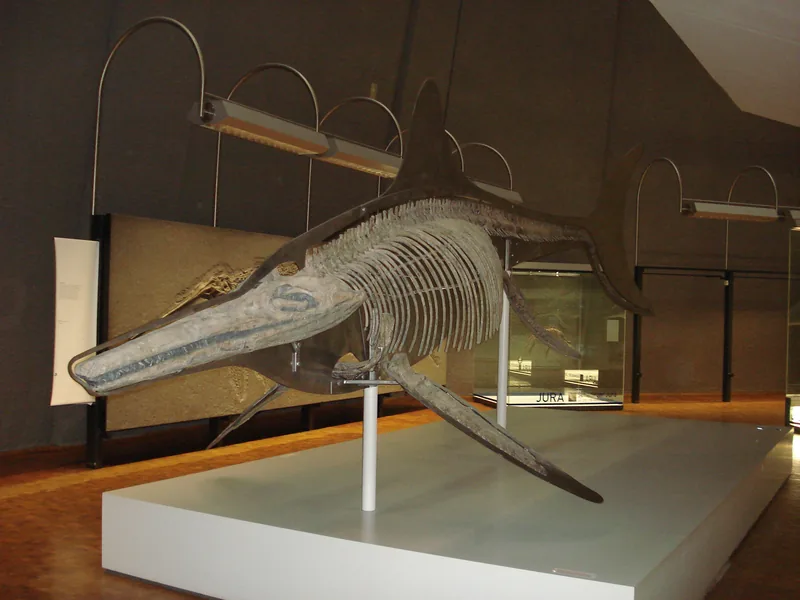
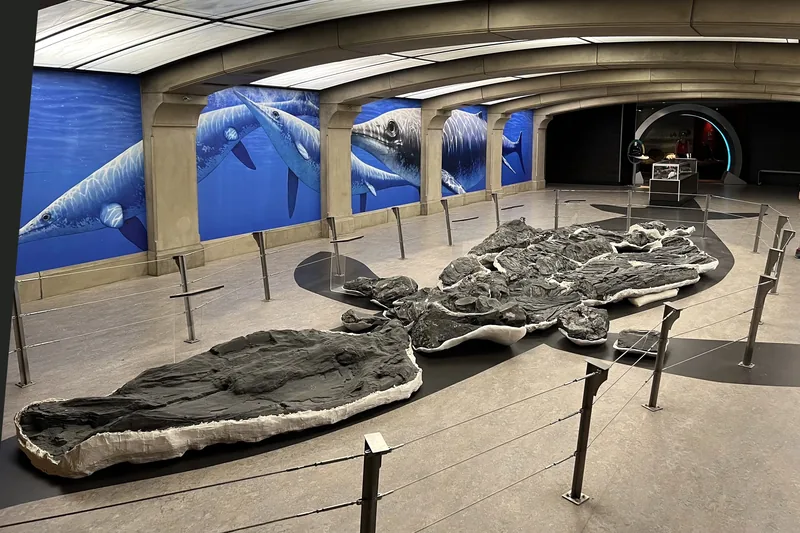
In the UK, “one famous example of an inland ichthyosaur is known as the Rutland ichthyosaur, Rutland Sea Dragon or, more formally, as the species Temnodontosaurus trigonodon.” “It was found in Rutland Water, in the East Midlands, around 60 kilometres from the coast, during maintenance work on the reservoir in 2021.” “The 10-metre-long animal is currently the largest ichthyosaur ever found in the UK, and there are plans for it to go on display in a museum near to where it was discovered.” The Temnodontosaurus trigonodon photograph on this page was taken at the Staatliches Museum für Naturkunde Stuttgart in 2010. It is not the Rutland specimen.[source]
“However, more incomplete fossils from other parts of the UK suggest even bigger ichthyosaurs once lived in the surrounding oceans.” “The largest ichthyosaur is Ichthyotitan severnensis, a species known from jaw fossils discovered in Somerset, UK.” “While the rest of the skeleton is missing, comparisons of the jaw bones with other ichthyosaurs suggest that Ichthyotitan’s size was as much as 25 metres long.” Official wording says that would make it “the biggest ichthyosaur ever known” and “the largest marine reptile as well,” “around the same length as the average blue whale.”[source]
Ichthyotitan is thought to be “the last known member of a wider group of giant ichthyosaurs known as the shastasaurids.” These species “existed for around 30 million years until the end of the Late Triassic, 201 million years ago, and have been found in Asia, Europe and North America.” “Though no other shastasaurid was as big as Ichthyotitan, species such as Shastasaurus and Shonisaurus still measured between 15 and 21 metres long.” That is an official group range. A photograph on this site of Shonisaurus sikanniensis at the Royal Tyrrell Museum carries a file caption of 21 metres; that figure stays with the file, and is not used to confirm the official range.[source]
“Nevada’s state fossil is the ichthyosaur Shonisaurus popularis.” That official sentence names a different species from the S. sikanniensis still on this page, and is not treated as a caption for the photograph.[source]
Enjoyed this sea-dragon desk?
No pop-ups. No intrusive advertising. Just interesting stuff. A little support helps the next fossils.im site get built.