Mary Anning
A cabinetmaker’s daughter, and a five-metre skeleton
“A pioneering palaeontologist and avid fossil collector, Mary Anning’s discoveries have contributed significantly to modern-day science. But until recently, she was relatively unknown.” She “was born in 1799 in Lyme Regis, which is now part of what’s known as the Jurassic Coast.”[source]
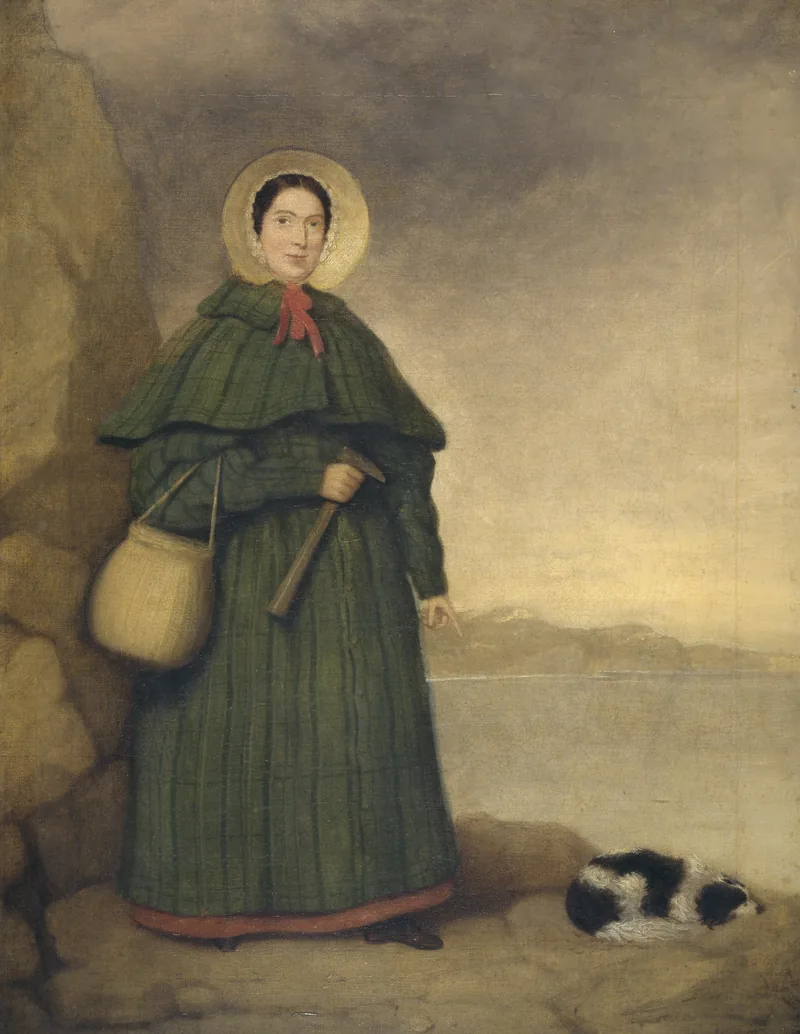
“The Anning family were religious dissenters — Protestants who separated from the Church of England. They were very poor. Out of nine children, only Mary and her older brother, Joseph, survived to adulthood.” Mary’s father, Richard, “was a cabinetmaker and amateur fossil collector.” “By the time she was five or six, Mary was his fossil-collecting sidekick — an otherwise unfathomable activity for Georgian girls.” He “taught his daughter how to look for and clean the fossils they found on the beach,” and sold them from his shop. Richard died suddenly in 1810 “from tuberculosis and previous injuries.” Joseph became an apprentice upholsterer, and their mother, Molly, “encouraged Mary to help pay off the family’s debts by selling her finds.”[source]
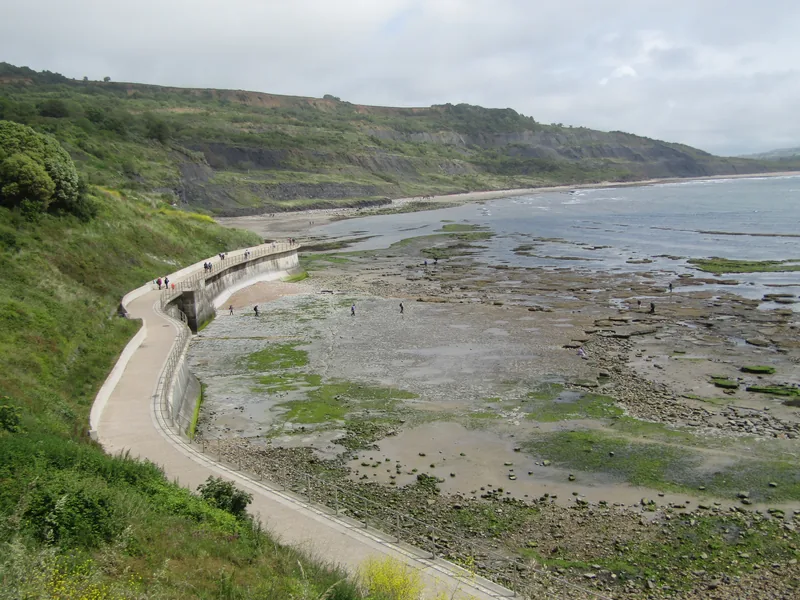
Lyme Regis, the official page says, “is especially rich in ammonites — which were called ‘Ammon’s horn’ — and belemnites, meaning ‘devil’s fingers’.” During the Napoleonic Wars, “people were encouraged to holiday near home rather than abroad, so tourists flocked to seaside towns such as Lyme Regis.” Fossil hunting “was perfect for fashionable Georgians seeking to add to their cabinets of curiosities.”[source]
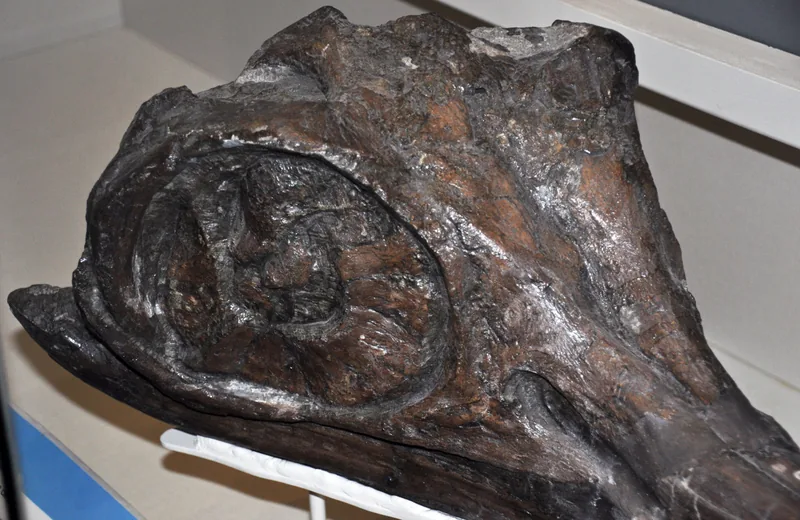
The first ichthyosaur of her story is told on that page with its own dates, kept here as written: autumn of 1811, Mary aged 12, Joseph’s skull; November 1812, a five-metre outline; several months later, a town that thought she had found a monster, and scientists who thought it was a crocodile. “By 1820, it was recognised as being an extinct marine reptile and named Ichthyosaurus.” “Although this wasn’t the first ichthyosaur to be found, it was the first to be scientifically studied and described in literature.”[source]
Her later finds sit beside that story, so the ichthyosaur is not left alone on the shore. In December 1823, “Mary was the first to discover the complete skeleton of a Plesiosaurus.” The news spread so quickly “that soon there were rumours that the fossil was a fake.” Georges Cuvier “thought it was either a fake, an error or a composite.” “A special meeting was scheduled at the Geological Society of London, though Mary was not invited.” Further illustrations reassured Cuvier that it was real. “Despite her growing reputation for finding and identifying fossils, the scientific community was hesitant to recognise Mary’s work.” Male scientists “often didn’t credit her discoveries in their scientific papers, even when writing about her groundbreaking ichthyosaur find.” “Even the Geological Society of London refused to admit her — they didn’t allow women to become Fellows until 1908.”[source]
In December 1828 she uncovered “a strange jumble of bones, this time with a long tail and wings,” remains attributed to Dimorphodon, “the first pterosaur ever discovered outside Germany.” She also “pioneered the study of coprolites, which is fossilised poo.” In 1830 her childhood friend Henry De la Beche painted ‘Duria Antiquior — A More Ancient Dorset’ and “sold prints to raise money for Mary, who was still struggling to make ends meet.” Official wording calls that painting “the very first pictorial representation of prehistoric life based on fossil evidence.”[source]
“Mary died from breast cancer in 1847. She was only 47 years old and still in financial strain despite a lifetime of extraordinary scientific discoveries.” “In 2022, a statue was unveiled of Mary and her dog in Lyme Regis after a campaign by 11-year-old Evie Swire.” Visitors to the Natural History Museum, the official page says, “can see several of Mary’s spectacular finds on display, including her ichthyosaur, plesiosaur and pterosaur.”[source][source]
Enjoyed this sea-dragon desk?
No pop-ups. No intrusive advertising. Just interesting stuff. A little support helps the next fossils.im site get built.