Discoveries
Sixteen stories from the official record
16 researched discoveries, each tied to an official Natural History Museum sentence, and written so that a reader who had never much cared for marine reptiles might still want to tell someone else.
Sea-dragon stories, real reptiles
“For centuries, the remains of prehistoric sea creatures have inspired extraordinary myths and legends.” Official wording then turns: they “weren’t legends, but real reptiles.”[source]
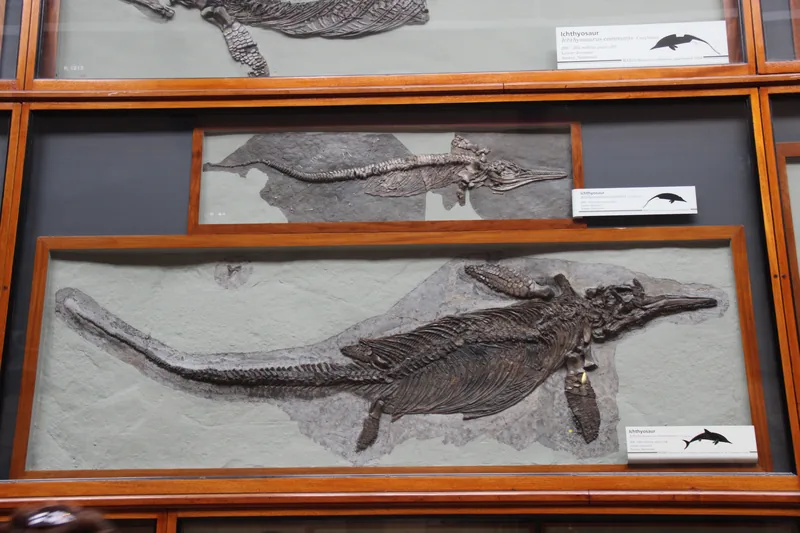
Skeletons of Ichthyosaurus communis in London, photographed by Gary Todd on 2 August 2017. The file identifies the species; it does not name a particular historical collector. Licensed CC0. Photo: Gary Todd, 2 August 2017 · CC0 · Wikimedia Commons A name that didn’t catch on
Sir Everard Home gave the animals the name Proteosaurus in 1819. “However, this name didn’t catch on.” Ichthyosaurus had been coined by Charles Konig in 1817.[source]
Not a dinosaur
“Though they’re both reptiles and lived at the same time, dinosaurs aren’t closely related to ichthyosaurs. The dinosaurs lived on land, whereas ichthyosaurs never left the water.”[source]
Lhwyd’s fish bone, twice dated
The first known illustration was published by Edward Lhwyd in 1695, “who at the time mistook it for a fish bone.” The same official page also mentions his first known illustrations of vertebrae in 1699. Both dates are kept.[source]
A skull, and two official years
A collection page dates Joseph Anning’s skull to 1810. A discover page, and the Mary Anning page, say 1811. This desk keeps both.[source][source][source]
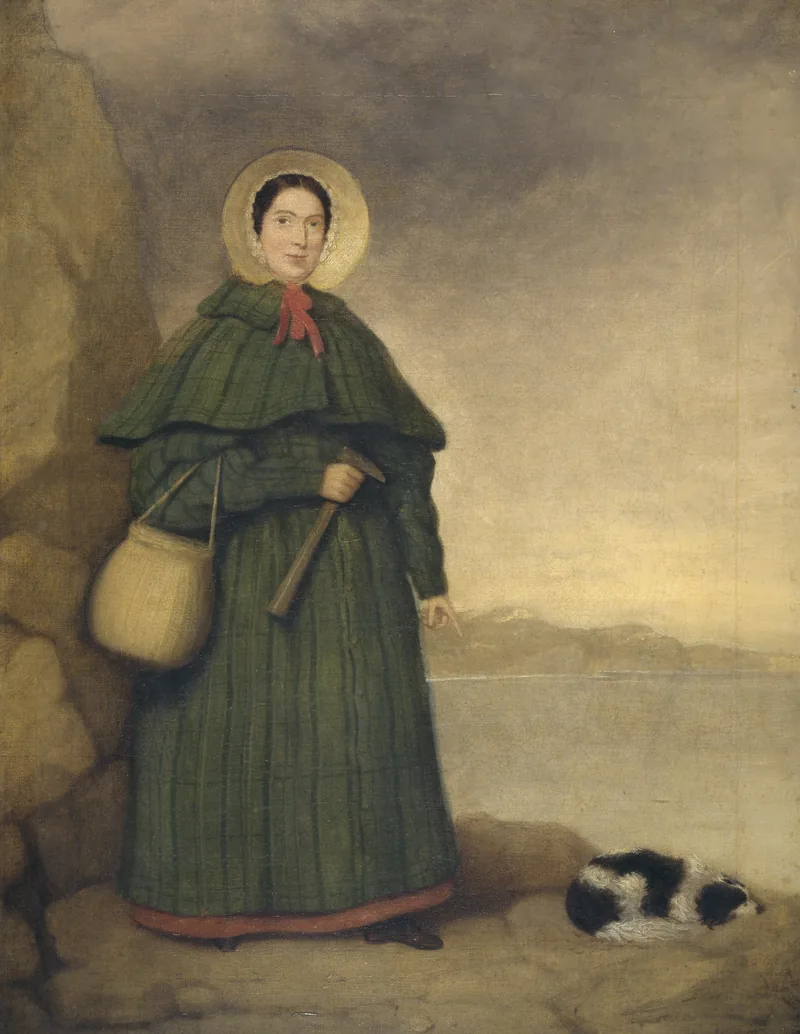
A portrait of Mary Anning by an unknown artist, painted before 1842. This is a historical painting, not a photograph of a fossil. Public domain. Painting: Unknown artist, before 1842 · Public domain · Wikimedia Commons Which kind of first?
The collection page says “the first ever discovered.” The Mary Anning page says it “wasn’t the first ichthyosaur to be found,” but the first scientifically studied and described. The discover page calls it, by early 1813, “the first largely complete specimen.”[source][source][source]
They had live young
A Stenopterygius fossil, official wording says, reveals that ichthyosaurs “didn’t lay eggs but instead had live births,” in the open ocean. A gallery page, kept separate, mentions six unborn young, and a specimen preserved giving birth.[source][source]
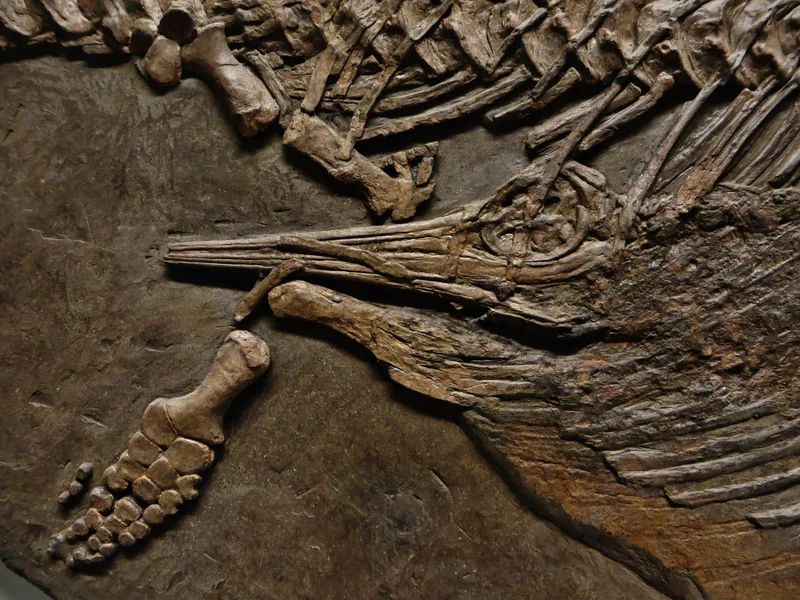
Stenopterygius quadriscissus with an embryo, photographed by Ghedoghedo on 19 August 2015. The official Natural History Museum discover page uses a Stenopterygius specimen to show that ichthyosaurs had live young. This photograph is not identified here as a particular gallery specimen in London. Licensed CC BY-SA 4.0; used on the website only. Photo: Ghedoghedo, 19 August 2015 · CC BY-SA 4.0 · Wikimedia Commons Eyes more than 22 centimetres across
“The eyes of the ichthyosaur Ophthalmosaurus grew to more than 22 centimetres in diameter. For its size, it has the biggest eyes of any animal that ever lived.”[source]
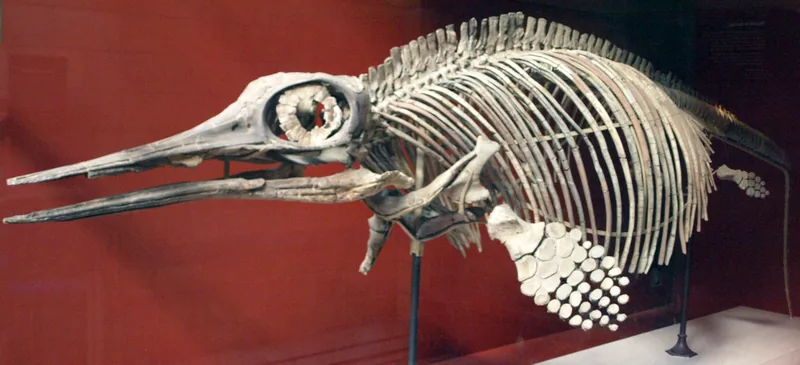
A skeleton labelled Ophthalmosaurus icenius in the Natural History Museum, London, photographed by Captmondo on 23 August 2008. The file says the specimen is from Oxford Clay, Peterborough, in the Callovian of the Middle Jurassic. Official collection wording uses the spelling Ophthalmosaurus icenicus for the Callovian Leeds collection. This caption keeps the file’s spelling with the photograph. Licensed CC BY-SA 3.0; used on the website only. Photo: Captmondo, 23 August 2008 · CC BY-SA 3.0 · Wikimedia Commons A sea dragon inland
The 10-metre Rutland ichthyosaur, Temnodontosaurus trigonodon, was found about 60 kilometres from the coast in 2021, and is currently the largest ichthyosaur found in the UK.[source]
As long as a blue whale?
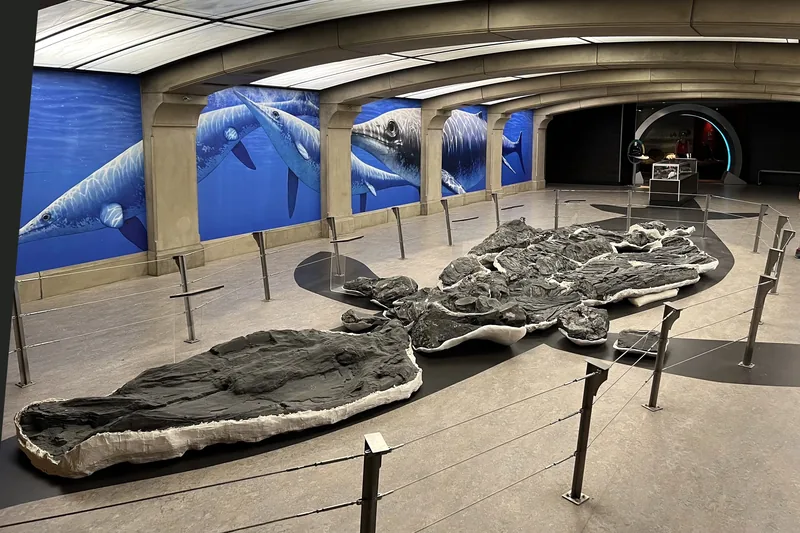
Comparisons of jaw bones suggest Ichthyotitan severnensis was as much as 25 metres long — around the same length as the average blue whale, on that official wording. The rest of the skeleton is missing.[source]
Shonisaurus sikanniensis on display at the Royal Tyrrell Museum, Drumheller, photographed by Jpmourez on 1 August 2022. The file caption gives a length of 21 metres for this animal; that figure stays with the file. Official Natural History Museum wording says species such as Shastasaurus and Shonisaurus measured between 15 and 21 metres, as a group range, and is kept on the How big? page. Licensed CC BY-SA 4.0; used on the website only. Photo: Jpmourez, 1 August 2022 · CC BY-SA 4.0 · Wikimedia Commons A 15-to-21-metre range, and a file’s 21 metres
Official wording says Shastasaurus and Shonisaurus “still measured between 15 and 21 metres long.” A Shonisaurus sikanniensis file caption of 21 metres stays with that file.[source]
No echolocation, even if they look like dolphins
“While some ichthyosaurs looked similar to dolphins, there’s no evidence that they could echolocate in the same way.” Their dolphin-like shape is officially described as convergent evolution.[source]
A meal almost as big as the hunter
A five-metre Guizhouichthyosaurus from China contains a crocodile-like thalattosaur “almost as big as the Guizhouichthyosaurus itself.” Official wording wonders whether it “bitten off more than it could chew.”[source]
A dorsal fin, recognised late
Soft-tissue fossils were first found around the 1840s; more complete specimens in the 1890s. Eberhard Fraas reported a fossil that “showed that these animals had a dorsal fin in the middle of their back.”[source]
Older than a mass extinction?
One official range is around 252 million years ago to about 94 million years ago. The same page also describes a final extinction around 90 million years ago. Research quoted there suggests ancestors already in the Late Permian, more than 252 million years ago.[source]
When Mary was 12
The Mary Anning page: in the autumn of 1811, when Mary was 12, Joseph found a strange-looking skull. In November 1812 she dug the outline of a five-metre-long skeleton.[source]
Enjoyed this sea-dragon desk?
No pop-ups. No intrusive advertising. Just interesting stuff. A little support helps the next fossils.im site get built.